Compliance report
The Compliance page turns the check runs on the Pull requests page into one report for a repository and a period: which rules were in effect, how each did, which exceptions were used, and what the commits declare about coding agents. It is built only from runs already uploaded or checked by Groundrule, so nothing new is collected, and the same report downloads as a CSV file for an auditor or a customer’s security reviewer.
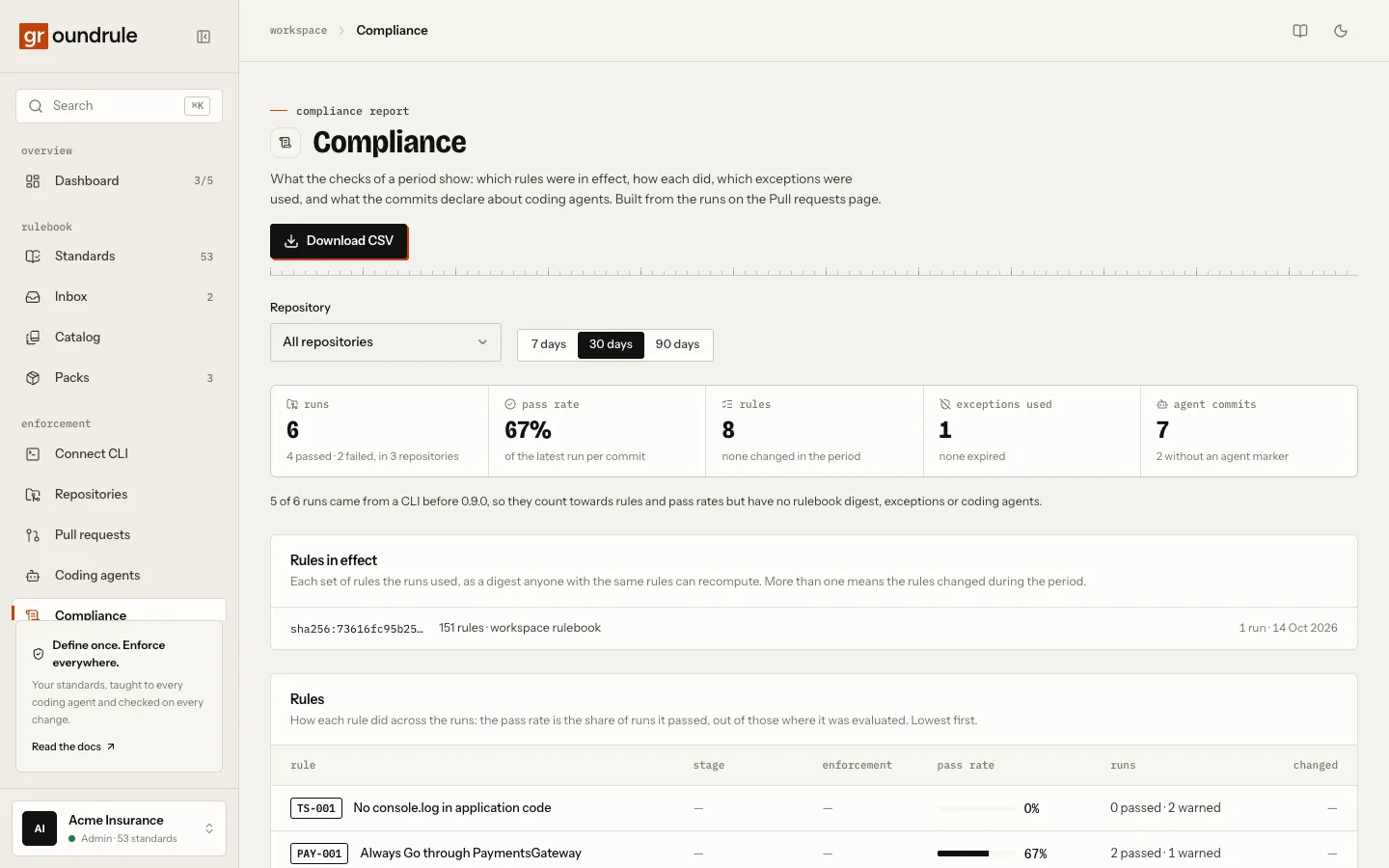
Open Compliance in the sidebar. Every member of the workspace can see it.
Choose what to report on
Section titled “Choose what to report on”- Repository: one of the repositories that uploaded a check, or All repositories.
- Period: the last 7 days, 30 days or 90 days. The API accepts any period up to 366 days (see the API).
The latest run of each commit counts. A commit checked twice, such as after Re-run on GitHub, counts once, with its latest result.
What you see
Section titled “What you see”The strip across the top:
| Item | What it shows |
|---|---|
| Runs | How many runs the period has, how many passed and failed, and in how many repositories. |
| Pass rate | The share of runs that passed. |
| Rules | How many rules the runs evaluated, and how many changed during the period. |
| Exceptions used | How many exceptions hid a finding, and how many of them have expired. |
| Agent commits | How many commits the runs declare, and how many carry no coding-agent marker. |
If some runs came from a CLI before 0.9.0, a line under the strip says how many: they count towards rules and pass rates, but carry no rulebook digest, exceptions or coding agents (see The compliance record).
Below it, seven panels:
| Panel | What it lists |
|---|---|
| Where violations are stopped | Three counts for the period, never added together: flagged in the agent loop (what the stop hook and the MCP check tool told coding agents before a commit existed, counted once per session and rule), flagged on pull requests (findings in checks of changed files on pull requests, the latest run per commit), and on main (violations in the latest scan of each repository, a snapshot at the period’s end). Each shows its basis, its definition and its top rules; a chart has the three per week; then the counts per repository and per agent (checks, findings told, times stopped). A fourth, separate count, stopped before the action, is what the before-tool hook refused or had the developer confirm under action policies, with the policies behind it. See Where violations are stopped. |
| Pass rate over time | The share of runs that passed per day (periods up to 28 days) or per week (Monday to Sunday), with bars for how many runs each point has. A dashed line per coding agent (the three with most commits) shows the pass rate of the runs that declare it. Hover a point for its numbers; weeks without runs stay on the axis, so a gap is visible as a gap. |
| Rules in effect | Each set of rules the runs used, as a rulebook digest, with how many rules it had, where it came from (the workspace rulebook or the repository’s files), how many runs used it, and the dates it was seen. More than one digest means the rules changed during the period. |
| Rules | Every rule the runs evaluated, lowest pass rate first: its stage and enforcement (from the newest run that recorded them), the pass rate (the runs it passed, out of those where it was evaluated: passed, warned or failed; guidance and skipped don’t count), the counts, and Changed when more than one version of the rule was in effect. |
| By control | The rules grouped by the compliance controls they support, one tab per framework: SOC 2 (2017 Trust Services Criteria), ISO/IEC 27001:2022 Annex A, and any other framework the rules map to (OWASP ASVS, PCI DSS, HIPAA). Each control shows its ID and name, the rules that support it, the pass rate across those rules’ evaluations, and the exceptions that hid their findings. Only rules evaluated in the period appear. |
| Exceptions used | Every exception that hid a finding, soonest expiry first: the rule, the expiry date with Expired when it has passed, who approved it as written in .groundrule/exceptions.yaml, and how many findings it hid in how many runs. |
| Coding agents | Each coding agent the commits declare, most commits first: its commits out of all the period’s commits, the runs it appears in, and the pass rate of those runs. |
Where violations are stopped
Section titled “Where violations are stopped”The same panel is on the Dashboard for the last 30 days. It answers how much Groundrule catches before review, and it is built so the three numbers can each be defended:
- Flagged in the agent loop comes from the reports the stop hook and the MCP
checktool send from connected repositories (what the workspace learns): counts per rule, never code. A finding the agent was told about on three turns, until it fixed it, counts once, because reports in one agent session are merged by the most each rule was reported. - Flagged on pull requests comes from check results uploaded from CI or made by hosted checks, in
changesmode with a pull request; reruns of the same commit count once. - On main is what the latest scan of each repository found, as of its date: a snapshot, not a flow. It can only show repositories that are scanned.
The three are different populations, so the panel never adds them up or claims that an agent-loop finding “would have” reached a pull request. It needs CLI 0.16.0 or later in the agent’s repository for the first column; until then the column reads zero and says so.
- Stopped before the action (CLI 0.24.0 and later) is a fourth number, separate again: how many times the before-tool hook refused an action or had the developer confirm one, under your action policies, with the repositories and agents involved and the policies behind the decisions. It counts decisions, not findings, and is never added to the three columns.
Download the CSV
Section titled “Download the CSV”Download CSV saves the report with the same repository and period, as one file with a section per table: the summary, rules in effect, rules, exceptions used, where violations were stopped (the three columns with their basis, then per week), the pass rate per day or week (one column per coding agent), a “By control” section per framework, and coding agents. The file is named groundrule-compliance-<repository>-<from>-<to>.csv. Cells that start with =, +, - or @ are prefixed with an apostrophe, so a rule title or an approver’s name can’t run as a formula in a spreadsheet.
The API
Section titled “The API”The dashboard reads GET /v1/orgs/<workspace>/compliance, which you can call with your session or an API token:
| Parameter | Meaning |
|---|---|
repository |
One repository, such as acme/payments. By default, all. |
from, to |
The period, as ISO 8601 timestamps. By default, the last 30 days. At most 366 days apart. |
format |
json (default) or csv. |
At most 5,000 runs are read for one report.
Related
Section titled “Related”- Pull requests, where each run comes from
- The compliance record, what each run carries
- What we store